 Add to Chrome
 Add to Firefox
 Add to Edge
GlucoFM: A Dual-Stream Foundation Model for Continuous Glucose Monitoring
May 29, 2026
Continuous glucose monitoring (CGM) provides a dense view of daily metabolic physiology, yet existing generic time-series and CGM-specific foundation models often encode glucose traces as entangled single-stream sequences, leaving the distinct temporal structure of glycemic dynamics only implicitly modeled. We present GlucoFM, a lightweight CGM foundation model that aligns irregular recordings to a 24-hour chronological grid, preserves observation masks, and decomposes glucose dynamics into slow physiological state and transient event streams, capturing low-frequency glycemic baselines and short-term deviations that may reflect acute physiological responses or sensor artifacts. GlucoFM is pretrained on 109,066 hours of unlabeled CGM recordings from 477 subjects with two complementary objectives: masked contextual latent prediction over fused daily representations and temporal dynamics prediction over state and event streams. Across four diverse cohorts and seven clinical prediction tasks, GlucoFM achieves the strongest subject-disjoint linear-probing performance among evaluated baselines, improving average PR-AUC by 4.1 points over the best CGM-specific foundation model. Its gains are most pronounced on core metabolic outcomes, leading PR-AUC on all diabetes-risk and $β$-cell dysfunction tasks and on 3 of 4 insulin-resistance tasks. GlucoFM also achieves the best overall cross-dataset transfer performance and strong few-shot adaptation among evaluated methods, and consistent gains when aggregating multiple days for subject-level prediction, highlighting physiology-aware decomposition as an effective inductive bias for transferable CGM representation learning.

Toward User Preference Alignment in LLM Recommendation via Explicit Context Feedback
May 27, 2026Traditional recommender systems (RecSys) primarily infer user preferences from implicit signals (such as clicks, watches, and purchases), often neglecting the rich explicit contextual feedback users provide through verbal text, like comments and reviews. This explicit context feedback captures the nuanced reasons behind user decisions regarding their preferences. In addition, it offers critical heterogeneous information for user preference alignment and more explainable recommendations. Overlooking such signals can lead to misaligned user preferences and further reinforce filter bubbles, as algorithms fail to understand the "semantic context" behind user choices. Recent advances in Large Language Models (LLMs) present new opportunities to harness user-generated content for more accurate and diverse recommendations, yet current LLM-based recommendations still focus on using item meta-data and underutilize this resource. In this paper, we advocate for prioritizing explicit context feedback in the next generation of LLM-based RecSys. We review the evolution of recommendation paradigms, highlight the value of context-rich feedback, call for new benchmarks and metrics, and introduce frameworks for integrating explicit user signals into scalable LLM-driven RecSys. Centering on user-preference modeling, we aim to foster more personalized, transparent, and explainable RecSys online platforms.
SciCustom: A Framework for Custom Evaluation of Scientific Capabilities in Large Language Models
May 19, 2026Large language models (LLMs) are increasingly applied to scientific research, yet existing evaluations often fail to reflect the fine-grained capabilities required in practice. Most benchmarks are manually curated or domain-generic, limiting scalability and alignment with real scientific use cases. In this paper, we propose a new framework named SciCustom to address the problem. It enables the custom construction of benchmarks from large-scale scientific data to evaluate application-specific scientific capabilities in LLMs. SciCustom first organizes scientific knowledge into ontology-grounded knowledge units with controlled granularity and trains a tagger to map large-scale data instances into this knowledge space. Given a custom requirement, relevant knowledge units are identified via voting-based multi-model consensus. These units enable relevance-aware benchmark retrieval via binary search, followed by proxy subset selection and data-grounded benchmark generation for efficient evaluation. Experiments in chemistry and healthcare demonstrate that SciCustom reveals fine-grained differences in LLM scientific capabilities that standard benchmarks overlook, while requiring neither expert annotation nor synthetic question generation. This work provides a scalable and application-aware foundation for benchmarking scientific capabilities in LLMs. The source code is available at https://github.com/yjwtheonly/SciCustom.
GAM: Hierarchical Graph-based Agentic Memory for LLM Agents
Apr 14, 2026To sustain coherent long-term interactions, Large Language Model (LLM) agents must navigate the tension between acquiring new information and retaining prior knowledge. Current unified stream-based memory systems facilitate context updates but remain vulnerable to interference from transient noise. Conversely, discrete structured memory architectures provide robust knowledge retention but often struggle to adapt to evolving narratives. To address this, we propose GAM, a hierarchical Graph-based Agentic Memory framework that explicitly decouples memory encoding from consolidation to effectively resolve the conflict between rapid context perception and stable knowledge retention. By isolating ongoing dialogue in an event progression graph and integrating it into a topic associative network only upon semantic shifts, our approach minimizes interference while preserving long-term consistency. Additionally, we introduce a graph-guided, multi-factor retrieval strategy to enhance context precision. Experiments on LoCoMo and LongDialQA indicate that our method consistently outperforms state-of-the-art baselines in both reasoning accuracy and efficiency.
When Users Change Their Mind: Evaluating Interruptible Agents in Long-Horizon Web Navigation
Apr 01, 2026As LLM agents transition from short, static problem solving to executing complex, long-horizon tasks in dynamic environments, the ability to handle user interruptions, such as adding requirement or revising goals, during mid-task execution is becoming a core requirement for realistic deployment. However, existing benchmarks largely assume uninterrupted agent behavior or study interruptions only in short, unconstrained language tasks. In this paper, we present the first systematic study of interruptible agents in long-horizon, environmentally grounded web navigation tasks, where actions induce persistent state changes. We formalize three realistic interruption types, including addition, revision, and retraction, and introduce InterruptBench, a benchmark derived from WebArena-Lite that synthesizes high-quality interruption scenarios under strict semantic constraints. Using a unified interruption simulation framework, we evaluate six strong LLM backbones across single- and multi-turn interruption settings, analyzing both their effectiveness in adapting to updated intents and their efficiency in recovering from mid-task changes. Our results show that handling user interruptions effectively and efficiently during long-horizon agentic tasks remains challenging for powerful large-scale LLMs. Code and dataset are available at https://github.com/HenryPengZou/InterruptBench.
MemoryCD: Benchmarking Long-Context User Memory of LLM Agents for Lifelong Cross-Domain Personalization
Mar 26, 2026Recent advancements in Large Language Models (LLMs) have expanded context windows to million-token scales, yet benchmarks for evaluating memory remain limited to short-session synthetic dialogues. We introduce \textsc{MemoryCD}, the first large-scale, user-centric, cross-domain memory benchmark derived from lifelong real-world behaviors in the Amazon Review dataset. Unlike existing memory datasets that rely on scripted personas to generate synthetic user data, \textsc{MemoryCD} tracks authentic user interactions across years and multiple domains. We construct a multi-faceted long-context memory evaluation pipeline of 14 state-of-the-art LLM base models with 6 memory method baselines on 4 distinct personalization tasks over 12 diverse domains to evaluate an agent's ability to simulate real user behaviors in both single and cross-domain settings. Our analysis reveals that existing memory methods are far from user satisfaction in various domains, offering the first testbed for cross-domain life-long personalization evaluation.
Learning Query-Aware Budget-Tier Routing for Runtime Agent Memory
Feb 05, 2026Memory is increasingly central to Large Language Model (LLM) agents operating beyond a single context window, yet most existing systems rely on offline, query-agnostic memory construction that can be inefficient and may discard query-critical information. Although runtime memory utilization is a natural alternative, prior work often incurs substantial overhead and offers limited explicit control over the performance-cost trade-off. In this work, we present \textbf{BudgetMem}, a runtime agent memory framework for explicit, query-aware performance-cost control. BudgetMem structures memory processing as a set of memory modules, each offered in three budget tiers (i.e., \textsc{Low}/\textsc{Mid}/\textsc{High}). A lightweight router performs budget-tier routing across modules to balance task performance and memory construction cost, which is implemented as a compact neural policy trained with reinforcement learning. Using BudgetMem as a unified testbed, we study three complementary strategies for realizing budget tiers: implementation (method complexity), reasoning (inference behavior), and capacity (module model size). Across LoCoMo, LongMemEval, and HotpotQA, BudgetMem surpasses strong baselines when performance is prioritized (i.e., high-budget setting), and delivers better accuracy-cost frontiers under tighter budgets. Moreover, our analysis disentangles the strengths and weaknesses of different tiering strategies, clarifying when each axis delivers the most favorable trade-offs under varying budget regimes.
MemSkill: Learning and Evolving Memory Skills for Self-Evolving Agents
Feb 02, 2026Most Large Language Model (LLM) agent memory systems rely on a small set of static, hand-designed operations for extracting memory. These fixed procedures hard-code human priors about what to store and how to revise memory, making them rigid under diverse interaction patterns and inefficient on long histories. To this end, we present \textbf{MemSkill}, which reframes these operations as learnable and evolvable memory skills, structured and reusable routines for extracting, consolidating, and pruning information from interaction traces. Inspired by the design philosophy of agent skills, MemSkill employs a \emph{controller} that learns to select a small set of relevant skills, paired with an LLM-based \emph{executor} that produces skill-guided memories. Beyond learning skill selection, MemSkill introduces a \emph{designer} that periodically reviews hard cases where selected skills yield incorrect or incomplete memories, and evolves the skill set by proposing refinements and new skills. Together, MemSkill forms a closed-loop procedure that improves both the skill-selection policy and the skill set itself. Experiments on LoCoMo, LongMemEval, HotpotQA, and ALFWorld demonstrate that MemSkill improves task performance over strong baselines and generalizes well across settings. Further analyses shed light on how skills evolve, offering insights toward more adaptive, self-evolving memory management for LLM agents.
DREAM: Dual-Standard Semantic Homogeneity with Dynamic Optimization for Graph Learning with Label Noise
Jan 24, 2026Graph neural networks (GNNs) have been widely used in various graph machine learning scenarios. Existing literature primarily assumes well-annotated training graphs, while the reliability of labels is not guaranteed in real-world scenarios. Recently, efforts have been made to address the problem of graph learning with label noise. However, existing methods often (i) struggle to distinguish between reliable and unreliable nodes, and (ii) overlook the relational information embedded in the graph topology. To tackle this problem, this paper proposes a novel method, Dual-Standard Semantic Homogeneity with Dynamic Optimization (DREAM), for reliable, relation-informed optimization on graphs with label noise. Specifically, we design a relation-informed dynamic optimization framework that iteratively reevaluates the reliability of each labeled node in the graph during the optimization process according to the relation of the target node and other nodes. To measure this relation comprehensively, we propose a dual-standard selection strategy that selects a set of anchor nodes based on both node proximity and graph topology. Subsequently, we compute the semantic homogeneity between the target node and the anchor nodes, which serves as guidance for optimization. We also provide a rigorous theoretical analysis to justify the design of DREAM. Extensive experiments are performed on six graph datasets across various domains under three types of graph label noise against competing baselines, and the results demonstrate the effectiveness of the proposed DREAM.
DTRec: Learning Dynamic Reasoning Trajectories for Sequential Recommendation
Dec 16, 2025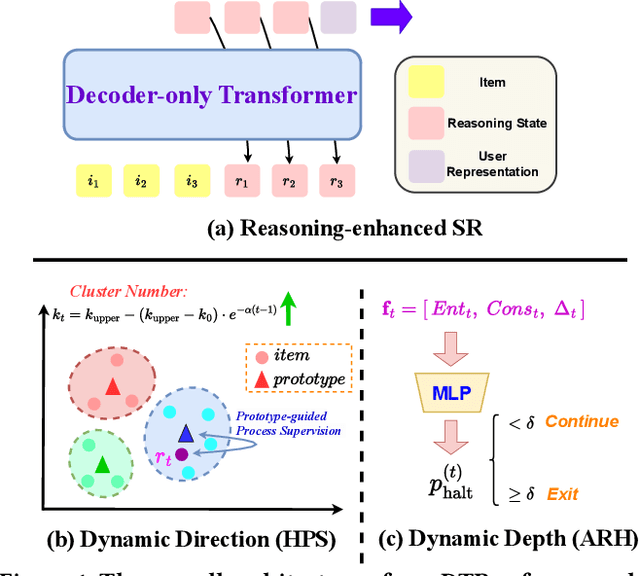
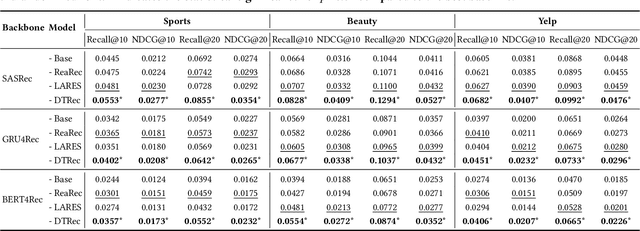
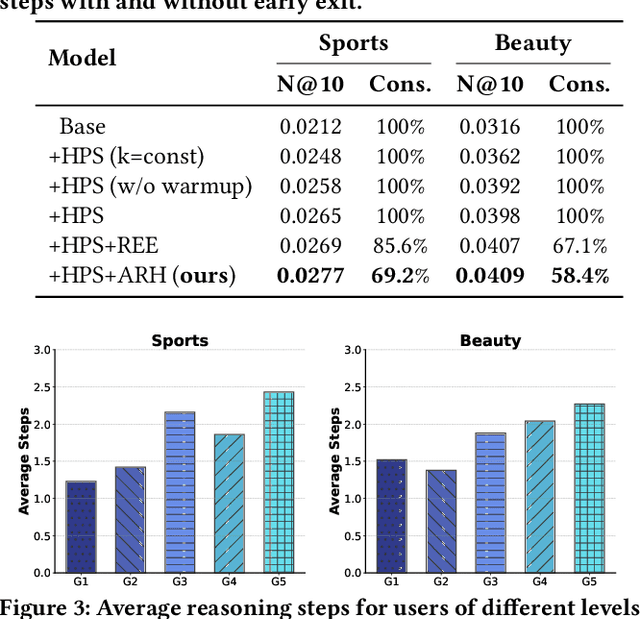
Inspired by advances in LLMs, reasoning-enhanced sequential recommendation performs multi-step deliberation before making final predictions, unlocking greater potential for capturing user preferences. However, current methods are constrained by static reasoning trajectories that are ill-suited for the diverse complexity of user behaviors. They suffer from two key limitations: (1) a static reasoning direction, which uses flat supervision signals misaligned with human-like hierarchical reasoning, and (2) a fixed reasoning depth, which inefficiently applies the same computational effort to all users, regardless of pattern complexity. These rigidity lead to suboptimal performance and significant computational waste. To overcome these challenges, we propose DTRec, a novel and effective framework that explores the Dynamic reasoning Trajectory for Sequential Recommendation along both direction and depth. To guide the direction, we develop Hierarchical Process Supervision (HPS), which provides coarse-to-fine supervisory signals to emulate the natural, progressive refinement of human cognitive processes. To optimize the depth, we introduce the Adaptive Reasoning Halting (ARH) mechanism that dynamically adjusts the number of reasoning steps by jointly monitoring three indicators. Extensive experiments on three real-world datasets demonstrate the superiority of our approach, achieving up to a 24.5% performance improvement over strong baselines while simultaneously reducing computational cost by up to 41.6%.